Flexible Placement Across Water Environments
One of PHY 332 W3FE’s biggest strengths is its broad production fit.
Current Southwest variety guidance classifies it as broadly adapted from dryland to good-water environments, making it useful for growers managing several fields with different irrigation capacities.
Potential placements include:
- Dryland cotton
- Limited-irrigation acres
- Full-irrigation production
- Southern High Plains
- Texas Panhandle
- Eastern New Mexico
- Fields with known nematode pressure
- Acres where Verticillium wilt is a concern
Rather than being positioned only for one narrow yield environment, PHY 332 W3FE gives growers more flexibility across the farm.
Weed & Insect Protection in One Trait Package
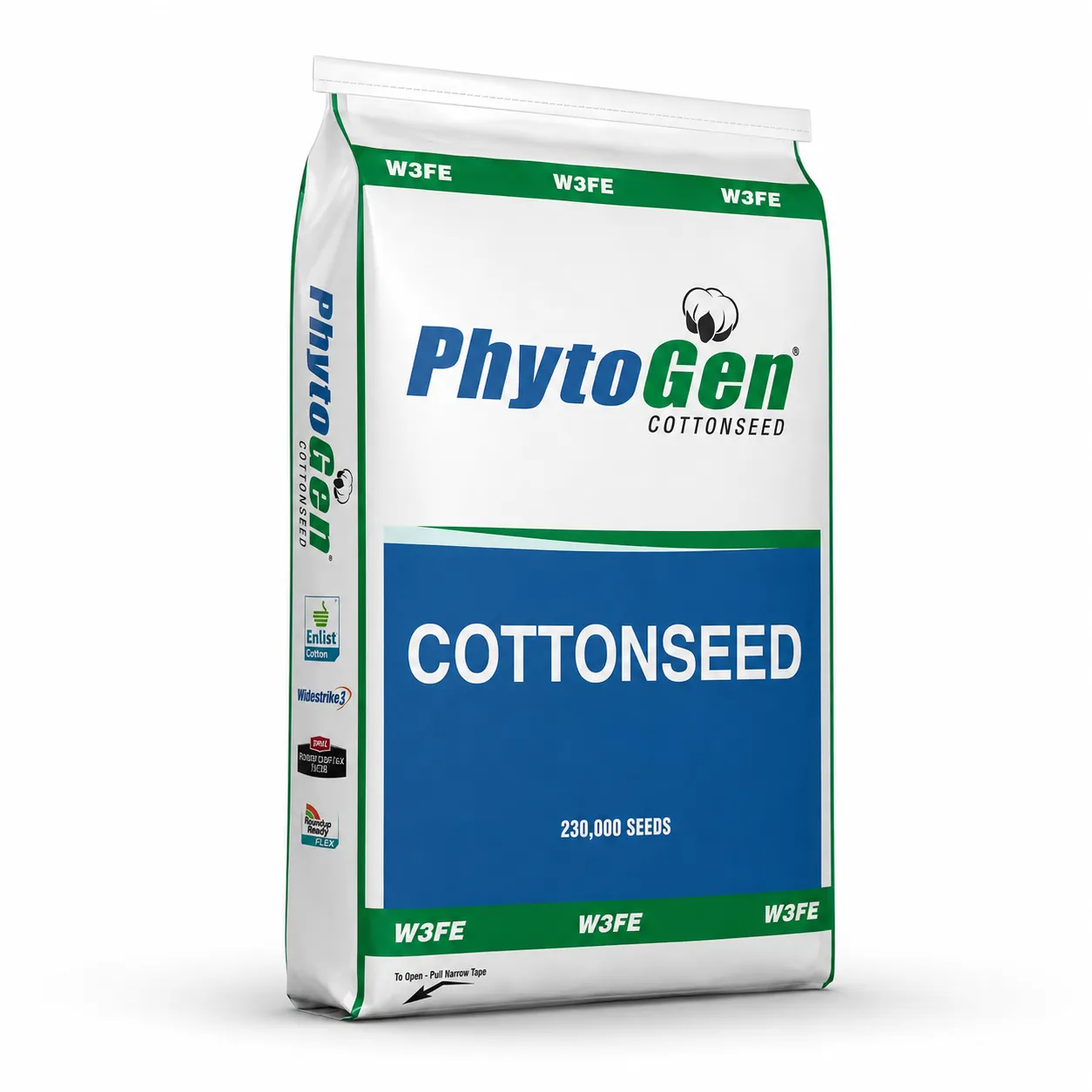
The W3FE designation represents a combination of WideStrike 3 insect protection and Enlist cotton herbicide tolerance.
WideStrike 3
WideStrike 3 is a three-gene Bt insect-protection technology designed to provide improved protection against targeted lepidopteran pests, including cotton bollworm.
Enlist Cotton
W3FE cotton provides tolerance to:
- 2,4-D choline
- Glyphosate
- Glufosinate
This gives growers several herbicide options within a complete resistance-management program.
Always follow current herbicide labels, trait stewardship requirements, refuge requirements, and resistance-management guidelines.
One of PHY 332 W3FE’s Biggest Strengths
PHY 332 W3FE carries resistance to both root-knot nematode and reniform nematode, making it especially valuable for fields with a history of nematode pressure.
These pests can reduce:
- Root development
- Water uptake
- Nutrient uptake
- Plant vigor
- Boll retention
- Yield potential
Nematode problems can also occur in patches, meaning affected areas may steadily expand across a field over time.
PHY 332 W3FE gives growers a genetic management tool rather than relying entirely on chemical or rotational strategies.
Key Features
Early-Mid Maturity
PHY 332 W3FE is classified as an early-mid maturity variety, giving it a good fit for Southwestern growing seasons.
Broad Water Adaptation
The variety is positioned from dryland through good-water production environments.
Root-Knot Nematode Resistance
Built-in resistance helps protect yield potential on infested fields.
Reniform Nematode Resistance
Reniform resistance is especially important in fields where this pest has become established.
Bacterial Blight Resistance
PHY 332 W3FE carries resistance to bacterial blight.
Verticillium Wilt Tolerance
Verticillium wilt tolerance adds another useful disease-management characteristic for West Texas.
WideStrike 3 Insect Protection
Three-gene Bt technology provides built-in protection against targeted caterpillar pests.
Enlist Herbicide Tolerance
The variety allows use of labeled 2,4-D choline, glyphosate, and glufosinate applications.
Added Protection for High Plains Fields
Verticillium wilt is an important disease consideration in portions of the Southern High Plains.
PHY 332 W3FE is listed with Verticillium wilt tolerance, which can provide added value in fields with a history of the disease.
When Planting on Verticillium Ground, Consider:
- Field disease history
- Irrigation level
- Variety tolerance
- Plant population
- Nitrogen management
- Local variety trials
Disease tolerance does not eliminate risk, but it can help improve consistency compared with more susceptible varieties.
Built-In Disease Protection
PHY 332 W3FE also carries bacterial blight resistance.
That can be useful in environments where moisture, storms, and susceptible varieties increase disease risk.
Resistance Helps By:
- Reducing disease-related yield risk
- Protecting leaf area
- Improving stand consistency
- Reducing dependence on variety avoidance alone
Variety resistance remains one of the most effective tools for managing bacterial blight.
Strong Southwest Fiber Characteristics
Current Southwest multi-year averages list PHY 332 W3FE at approximately:
Micronaire: 4.2
Staple Length: 1.17 inches
Strength: 30.5 g/tex
Leaf Type: Semi-Smooth
These characteristics help make PHY 332 W3FE useful for growers looking to balance agronomics and pest resistance with marketable fiber quality.
Actual fiber measurements will vary by environment, irrigation, harvest timing, and crop management.
Medium-Tall Plant with Semi-Smooth Leaf
Current Southwest data describes PHY 332 W3FE as:
Maturity: Early-Mid
Leaf Type: Semi-Smooth
Node of First Fruiting Branch: Approximately 7.2
Plant Height: Medium-Tall
Understanding plant architecture can help growers make better decisions around:
- Population
- Irrigation
- Nitrogen
- PGR management
- Row spacing
- Harvest preparation
What Does PHY 332 W3FE Bring to the Field?
Crop: Upland Cotton
Variety: PHY 332 W3FE
Trait Package: WideStrike 3 + Enlist
Maturity: Early-Mid
Irrigation Response: Broadly Adapted – Dryland to Good Water
Bacterial Blight: Resistant
Verticillium Wilt: Tolerant
Root-Knot Nematode: Resistant
Reniform Nematode: Resistant
Micronaire: Approximately 4.2
Staple Length: Approximately 1.17 inches
Strength: Approximately 30.5 g/tex
Leaf Type: Semi-Smooth
Node of First Fruiting Branch: Approximately 7.2
Plant Height: Medium-Tall
West Texas Fit: Excellent
What is PHY 332 W3FE Cotton?
PHY 332 W3FE is an early-mid maturity cotton variety with WideStrike 3 insect protection, Enlist herbicide tolerance, and resistance to several important cotton diseases and nematodes.
Is PHY 332 W3FE good for West Texas?
Yes. It is broadly adapted from dryland to good-water environments in Southwest production.
Is PHY 332 W3FE root-knot nematode resistant?
Yes. Root-knot nematode resistance is part of its genetic package.
Is PHY 332 W3FE reniform nematode resistant?
Yes. It also carries reniform nematode resistance.
Does PHY 332 W3FE tolerate Verticillium wilt?
Yes. Current Southwest guidance lists Verticillium wilt tolerance.
Is PHY 332 W3FE resistant to bacterial blight?
Yes.
What does W3FE mean?
W3FE indicates WideStrike 3 insect protection plus Enlist cotton with glyphosate tolerance.
What herbicides can Enlist W3FE cotton tolerate?
The trait provides tolerance to labeled uses of 2,4-D choline, glyphosate, and glufosinate.
What maturity is PHY 332 W3FE?
It is an early-mid maturity variety.
Is PHY 332 W3FE good for dryland cotton?
Yes. Current Southwest positioning lists it as broadly adapted from dryland through good-water environments.
What is the fiber quality of PHY 332 W3FE?
Southwest multi-year averages list approximately 4.2 micronaire, 1.17-inch staple, and 30.5 g/tex strength.
Has PHY 332 W3FE performed well under nematode pressure?
Yes. It has shown strong West Texas performance in nematode trials, including a reported 215 lb./acre lint advantage over the closest competitor in a Lubbock reniform trial.

Reviews
There are no reviews yet.