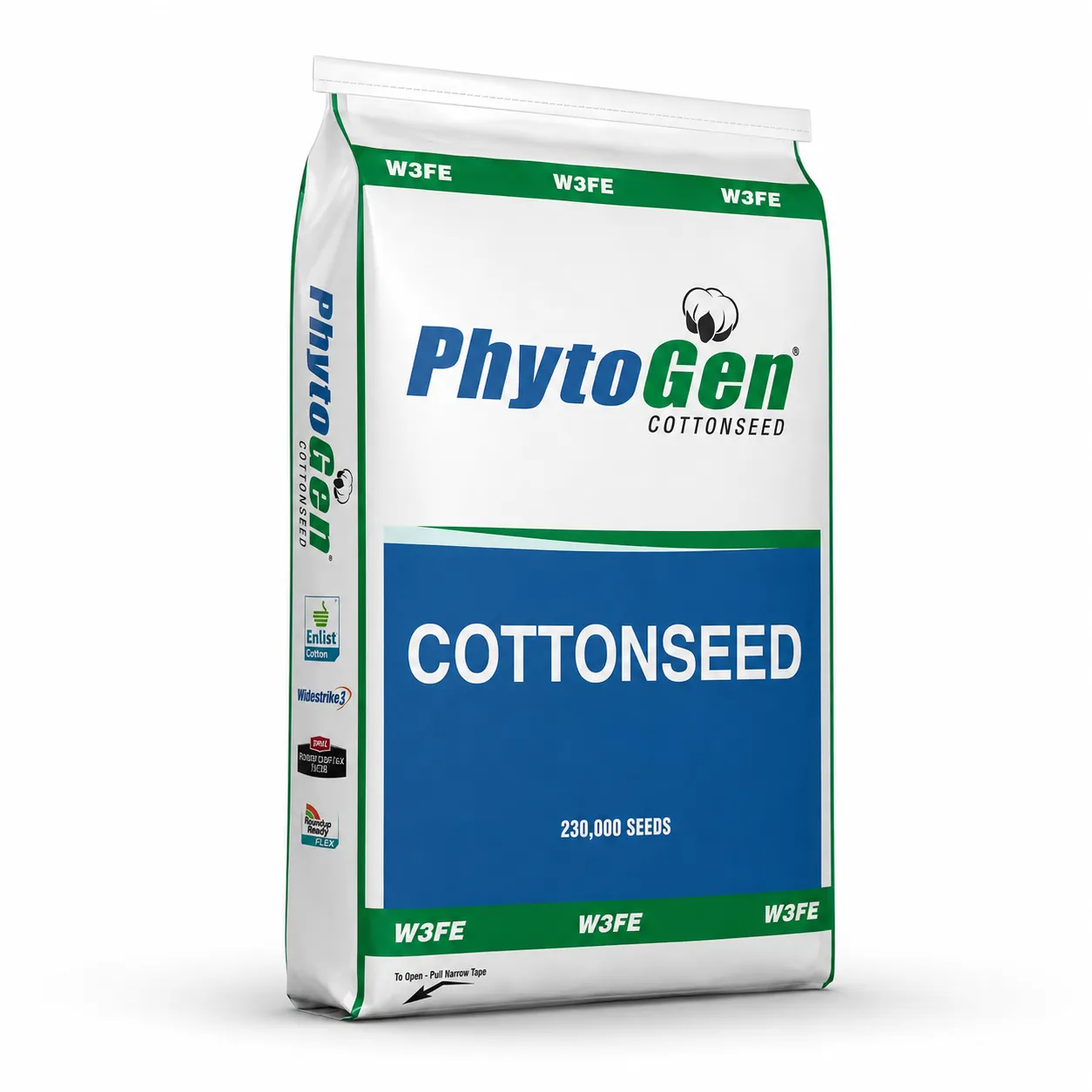
Push Productive Acres with PHY 400 W3FE
PHY 400 W3FE is especially attractive for growers looking to maximize production on stronger ground.
Current product information specifically describes the variety as having high yield potential and responding very well to:
- Plant growth regulators
- Higher inputs
- Productive soils
That makes it a strong candidate for acres where growers have the soil, fertility, irrigation, and management capacity to push cotton production.
Potential placements include:
- Productive irrigated acres
- Good-water environments
- High-yield cotton fields
- Stronger dryland ground
- Fields with root-knot nematode pressure
- Southern High Plains production
Modern Weed & Insect Protection
PHY 400 W3FE carries the WideStrike 3 insect protection trait along with the Enlist cotton trait and glyphosate tolerance. The current Southwest variety guide defines W3FE as WideStrike 3 insect protection, glyphosate tolerance, and the Enlist cotton trait.
WideStrike 3
WideStrike 3 provides trait-based protection against targeted lepidopteran cotton pests.
Enlist Cotton
The Enlist trait provides a flexible herbicide system for managing difficult weeds when used according to current labels and stewardship requirements.
Trait Package Benefits
- Built-in insect protection
- Flexible weed management
- Multiple herbicide options within the approved system
- Useful for resistance-management programs
- Strong fit for high-yield production systems
Always follow current labels, trait agreements, refuge requirements, and stewardship guidance.
Genetic Protection Where Root-Knot Pressure Matters
PHY 400 W3FE is listed with root-knot nematode resistance in current Southwest guidance.
Root-knot nematodes can reduce cotton performance by interfering with:
- Root development
- Water uptake
- Nutrient uptake
- Plant vigor
- Boll retention
- Yield potential
On fields with confirmed root-knot pressure, genetic resistance can be an important part of an integrated management program.
PHY 400 W3FE does not carry reniform nematode resistance in the current Southwest guide, so nematode species identification matters before placement.
Key Features
High Yield Potential
PHY 400 W3FE is specifically positioned around high yield potential.
Productive-Soil Response
The variety responds especially well on stronger, productive soils.
Higher-Input Response
PHY 400 W3FE is well suited to fields where growers are willing to invest in fertility, irrigation, crop protection, and plant growth management.
Root-Knot Nematode Resistance
Built-in root-knot resistance helps protect yield potential on affected acres.
Bacterial Blight Resistance
Current Southwest guidance lists PHY 400 W3FE as resistant to bacterial blight.
Early-Mid Maturity
In the Southwest Plains, PHY 400 W3FE is classified as early-mid maturity.
Broad Water Adaptation
The variety is positioned from dryland through good-water environments in the Southwest Plains.
Strong PGR Response
PHY 400 W3FE responds very well to plant growth regulators, making active growth management important.
Strong Fit for Southern High Plains Production
PHY 400 W3FE is particularly relevant for West Texas because the current Southwest Plains positioning combines:
- Early-mid maturity
- Broad dryland-to-good-water adaptation
- Root-knot nematode resistance
- Bacterial blight resistance
- Strong response to higher inputs
- High yield potential
Potential production areas include:
- Lubbock
- Levelland
- Brownfield
- Seminole
- Plainview
- Littlefield
- Muleshoe
- Texas Panhandle
- Eastern New Mexico
It can be especially attractive on productive acres where growers want to push lint yield while maintaining a strong trait and disease package.
Solid Southwest Fiber Characteristics
Current Southwest Plains multi-year data lists PHY 400 W3FE at approximately:
Micronaire: 4.1
Staple Length: 1.14 inches
Strength: 30.2 g/tex
These numbers are comparison values based on available multi-year university and company data, and actual results can vary with:
- Weather
- Irrigation
- Soil
- Harvest timing
- Maturity
- Fertility
- Crop stress
Fiber quality should always be evaluated alongside yield and loan value when comparing cotton varieties.
Built-In Protection Against an Important Cotton Disease
PHY 400 W3FE carries bacterial blight resistance in the current Southwest Plains variety guide.
This can be useful where field history or seasonal conditions increase bacterial blight risk.
Resistance Can Help:
- Reduce disease-related yield risk
- Protect leaf area
- Improve field consistency
- Simplify variety placement on affected ground
Resistance does not replace sound crop management, but it adds another level of protection.
What Does PHY 400 W3FE Bring to the Field?
Crop: Upland Cotton
Variety: PHY 400 W3FE
Trait Package: WideStrike 3 + Enlist + Glyphosate Tolerance
Southwest Maturity: Early-Mid
Yield Potential: High
Irrigation Response: Broadly Adapted – Dryland to Good Water
Productive-Soil Response: Excellent
Higher-Input Response: Excellent
PGR Response: Very Good
Bacterial Blight: Resistant
Root-Knot Nematode: Resistant
Reniform Nematode: No resistance listed in current Southwest guide
Verticillium Wilt: No tolerance listed in current Southwest guide
Micronaire: Approximately 4.1
Staple Length: Approximately 1.14 inches
Strength: Approximately 30.2 g/tex
Leaf Type: Semi-Smooth
Node of First Fruiting Branch: Approximately 6.8
Plant Height: Short-Medium
West Texas Fit: Very Good
What is PHY 400 W3FE Cotton?
PHY 400 W3FE is an upland cotton variety with high yield potential, strong response to higher inputs and productive soils, WideStrike 3 insect protection, and Enlist herbicide technology.
What maturity is PHY 400 W3FE?
In the Southwest Plains, it is classified as early-mid maturity.
Is PHY 400 W3FE good for West Texas?
Yes. Its Southwest Plains positioning includes broad adaptation from dryland to good-water environments, making it relevant to West Texas production.
Is PHY 400 W3FE good for irrigated cotton?
Yes. It responds very well to higher inputs and productive soils, making irrigated and high-yield environments a natural fit.
Can PHY 400 W3FE be planted dryland?
Yes. Current Southwest guidance describes it as broadly adapted from dryland to good water.
Is PHY 400 W3FE root-knot nematode resistant?
Yes, except the product page notes Arizona as an exception to the general root-knot resistance statement. For Southwest Plains placement, current guidance lists RKN resistance.
Is PHY 400 W3FE reniform nematode resistant?
No reniform resistance is listed for PHY 400 W3FE in the current Southwest guide.
Is PHY 400 W3FE resistant to bacterial blight?
Yes. Current Southwest guidance lists bacterial blight resistance.
Does PHY 400 W3FE tolerate Verticillium wilt?
Verticillium tolerance is not listed for PHY 400 W3FE in the current Southwest guide.
What is the fiber quality of PHY 400 W3FE?
Southwest multi-year comparison data lists approximately 4.1 micronaire, 1.14-inch staple, and 30.2 g/tex strength.
Does PHY 400 W3FE respond well to PGRs?
Yes. Strong response to plant growth regulators is specifically highlighted as one of the variety’s characteristics.

Reviews
There are no reviews yet.