Forage Above Ground & Below
Purple Top Turnip provides two sources of usable forage: leafy tops above the soil and a large, fleshy root below ground. This makes it particularly useful in grazing systems where livestock can utilize both portions of the plant.
NRCS describes turnips as cool-season brassicas that can capture nitrogen, help reduce soil compaction, and provide quality grazing, making them useful for both forage and soil-health programs.
Purple Top Turnip is an excellent option for:
- Fall grazing
- Winter forage
- Wildlife food plots
- Cover crop blends
- Nutrient scavenging
- Soil-building programs
- Crop rotations
- Cool-season forage acres
High-Quality Cool-Season Forage
Purple Top Turnip grows rapidly and can produce significant amounts of palatable forage during cool weather. Livestock can consume the leafy tops first and then graze the roots as the stand matures.
A Texas retailer describes Purple Top White Globe as a rapidly growing brassica used for fall livestock and wildlife grazing, with both the root and leafy foliage available for consumption.
Grazing Benefits
- Rapid fall forage production
- Palatable leafy growth
- Edible roots
- Good fit for cattle, sheep, and goats
- Adds brassica diversity to small-grain pastures
- Extends grazing opportunities into cooler weather
For best results, turnips are often mixed with grasses such as wheat, rye, oats, or triticale rather than planted as the only forage species.
A Root Crop That Works Below the Surface
Purple Top Turnip doesn’t produce the same long, penetrating taproot as a forage radish, but its swollen root and branching roots still contribute valuable below-ground biomass.
NRCS identifies turnips as useful for reducing soil compaction while also increasing plant diversity in cover crop mixtures.
Soil-Health Benefits
- Adds root diversity
- Helps loosen surface soil
- Adds below-ground organic matter
- Improves cover crop diversity
- Provides rapid soil coverage
- Complements fibrous-rooted small grains
As roots break down after grazing or termination, they leave organic material behind within the upper soil profile.
Capture Nitrogen Already in the Soil
Purple Top Turnip is not a nitrogen-fixing crop. Like radish and other brassicas, its value comes from capturing nutrients that are already present in the soil.
NRCS specifically notes that turnips can help capture nitrogen in the field.
This makes Purple Top Turnip useful following crops where residual fertility remains available.
Benefits
- Captures residual nitrogen
- Holds nutrients in plant tissue
- Helps improve nutrient cycling
- Complements nitrogen-fixing legumes
- Works well after fertilized cash crops
After termination or grazing, nutrients contained in the plant residue can cycle back through the soil system.
Why Choose Purple Top Turnip Seed?
Rapid Establishment
Turnips germinate and establish quickly under favorable cool-season conditions, providing useful ground coverage in a relatively short planting window.
Productive Leaf Growth
Purple Top Turnip produces a leafy canopy that provides highly palatable grazing forage.
Large Globe-Shaped Root
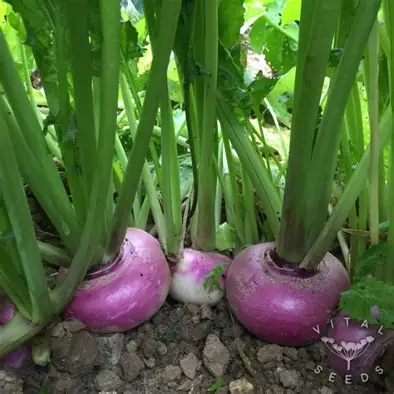
Purple Top White Globe develops a distinctive round root with white lower portions and purple shoulders above the soil surface.
Nutrient Scavenging
Turnips help capture available nitrogen rather than leaving it unused in the soil profile.
Excellent Grazing Potential
Both leaves and roots can be grazed, giving livestock access to substantial cool-season forage.
Wildlife Value
Turnips are highly attractive to deer and can provide forage during fall and winter when native food sources become limited. NRCS notes that cool-season cover crops can improve winter and early-spring wildlife forage availability.
A Cool-Season Option for High Plains Farms & Ranches
Purple Top White Globe has direct relevance to the Southern High Plains. Texas A&M AgriLife’s Lubbock vegetable variety recommendations specifically list Purple Top White Globe among recommended turnip varieties.
For West Texas growers, Purple Top Turnip can fit well into mixtures with:
- Wheat
- Triticale
- Cereal rye
- Oats
- Barley
- Radish
- Clover
- Winter peas
- Other brassicas
The combination of brassicas, small grains, and legumes can create a more diverse cool-season forage and cover crop than relying on a single species alone.
Purple Top Turnip Planting Recommendations
Purple Top Turnip is a small-seeded crop that should be planted shallow with good seed-to-soil contact.
General Planting Information
- Crop Type: Cool-season brassica
- Species: Brassica rapa
- Growth Habit: Biennial typically managed as an annual
- Primary Uses: Grazing, wildlife, cover crops, and root production
- Planting Season: Late summer through fall; spring planting is also possible
- Planting Depth: Approximately ⅛–½ inch
- Planting Method: Drill or broadcast
- Nitrogen Fixation: None
- Nutrient Scavenging: Good
A Texas seed retailer recommends approximately ⅛–½ inch planting depth for Purple Top White Globe.
Seeding Rate
For forage use, one Texas retailer recommends:
- Pure Stand Forage Rate: approximately 2–5 lb./acre
Rates should generally be reduced when Purple Top Turnip is included in a multi-species blend.
Planting rate will vary with:
- Drilled vs. broadcast planting
- Seedbed quality
- Moisture
- Forage objective
- Number of other species in the mix
Contact Jack Seed & Supply for a Purple Top Turnip planting recommendation for your acreage and grazing or cover crop goals.
What Does Purple Top Turnip Bring to the Field?
Crop Type: Cool-season brassica
Scientific Name: Brassica rapa
Common Variety Name: Purple Top White Globe
Primary Uses: Grazing, wildlife, cover crop, and root production
Planting Depth: Approximately ⅛–½ inch
Forage Seeding Rate: Approximately 2–5 lb./acre in pure stands
Root Type: Large globe-shaped storage root
Nitrogen Fixation: None
Nitrogen Scavenging: Good
Compaction Management: Good in upper soil profile
Grazing Value: Excellent
Wildlife Value: Excellent
Growth Rate: Fast
Season: Cool season
Texas Adaptation: Purple Top White Globe is recommended by Texas A&M AgriLife in the Lubbock region.
What is Purple Top Turnip?
Purple Top Turnip, commonly called Purple Top White Globe, is a cool-season brassica that produces both leafy forage and a round white root with a purple shoulder.
Is Purple Top Turnip good for grazing?
Yes. Both the tops and roots can be utilized by livestock, making Purple Top Turnip an excellent cool-season grazing crop.
Is Purple Top Turnip good for West Texas?
Yes. Texas A&M AgriLife’s Lubbock variety recommendations specifically include Purple Top White Globe.
How much Purple Top Turnip should I plant per acre?
For forage, a general pure-stand recommendation is approximately 2–5 lb./acre. Rates should be reduced when planting in a mixture.
How deep should Purple Top Turnip seed be planted?
Approximately ⅛ to ½ inch deep is a useful general range.
Does Purple Top Turnip fix nitrogen?
No. Turnips are brassicas, not legumes. They capture existing nitrogen from the soil rather than fixing atmospheric nitrogen.
Can deer eat Purple Top Turnips?
Yes. Turnips are commonly used in cool-season wildlife plots, and deer can utilize both leafy forage and roots.
Can Purple Top Turnip be planted with wheat?
Yes. Turnips work well with wheat and other small grains because the species provide different rooting patterns and forage characteristics.

Reviews
There are no reviews yet.