Four Crops Built for Summer Production
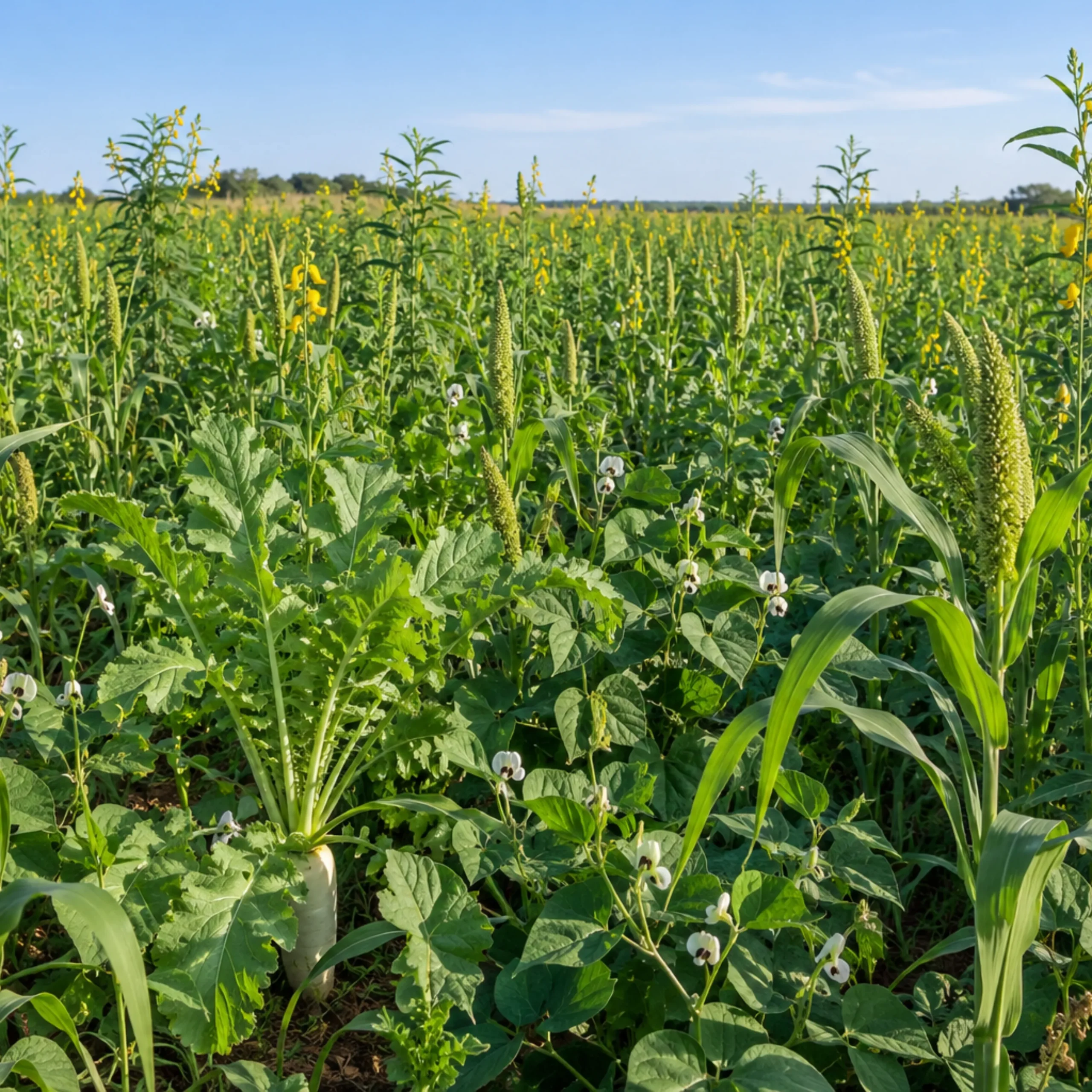
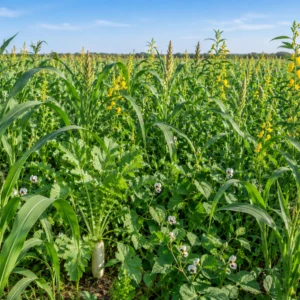
Summer Graze brings together four crops with different growth habits to create a more diverse summer pasture than a single-species planting.
The 38% millet component provides the grass foundation. Millet is valued for rapid warm-season growth, palatable forage, and its ability to perform during hot summer conditions.
Cowpeas make up 24% of the blend and contribute highly palatable broadleaf forage. As a warm-season legume, properly nodulated cowpeas can biologically fix atmospheric nitrogen while adding a different forage type to the stand.
Another 24% is sunn hemp, a vigorous warm-season legume capable of producing substantial biomass during hot weather. Sunn hemp adds upright growth, plant diversity, and additional nitrogen-fixation potential.
The final 14% radish adds another broadleaf component and a taproot that explores the soil differently from the fibrous roots of millet and the legume roots of cowpeas and sunn hemp.
Summer Grazing with Added Soil Benefits
Summer Graze is designed to produce useful forage above ground while creating a diverse root system below it.
For livestock producers, the blend offers a combination of grass and broadleaf forage that can provide summer grazing when properly established and managed. Millet serves as the primary grass component, while cowpeas and young sunn hemp contribute leafy forage.
For crop producers, the diversity also makes Summer Graze useful as a warm-season cover crop. Multiple plant families provide different canopy structures and rooting patterns, helping maintain living roots and soil cover during the summer.
The blend can therefore fit grazing-focused operations as well as producers looking to integrate livestock into a cover crop system.
Blend & Agronomic Profile
Blend Name: Summer Graze
Crop Type: Warm-Season Forage & Cover Crop Blend
Composition: 38% Millet / 24% Cowpeas / 24% Sunn Hemp / 14% Radish
Crop Diversity: Grass / Legumes / Broadleaf
Primary Use: Grazing / Forage / Cover Crop
Planting Season: Late Spring to Summer
Growth Habit: Warm-Season Annual Blend
Heat Tolerance: Excellent
Forage Potential: Excellent
Grazing Potential: Very Good
Biomass Potential: Excellent
Ground Cover: Very Good
Root Diversity: Excellent
Nitrogen Fixation Potential: Yes – Cowpeas & Sunn Hemp
Soil-Building Potential: Excellent
Regional Fit: West Texas, Texas High Plains, Oklahoma Panhandle & Eastern New Mexico
Production System: Dryland or Irrigated
Blend percentages are by seed weight. Because the seed size of millet, cowpeas, sunn hemp, and radish differs considerably, established plant populations will not occur in the same percentages as the seed mixture by weight.
Recommended Planting
Summer Graze should be planted after soils have warmed and the danger of frost has passed. Warm soil and adequate moisture are important for rapid emergence of the millet, cowpeas, and sunn hemp.
Recommended Seeding Rate:
Approximately 35–50 lb. per acre drilled is a practical starting range for a blend of this type. Final seeding rate should be adjusted for seed size, germination, planting method, available moisture, grazing goals, and desired stand density.
Planting Depth:
Because Summer Graze contains seeds of substantially different sizes, planting depth requires a compromise. Approximately ½–1 inch is a practical target when drilling the entire blend together into adequate moisture.
Avoid unnecessarily deep placement of the smaller millet and radish seed.
Planting Temperature:
Wait for consistently warm soil before planting. Cowpeas and sunn hemp are warm-season crops and should not be planted into cold soils simply because the calendar indicates spring.
For Grazing:
Allow the stand to become well established before introducing livestock. Rotational or controlled grazing can help prevent animals from selectively removing the most palatable species and improve utilization of the complete blend.
Fertility:
Base fertility on a soil test and realistic forage goals. Because cowpeas and sunn hemp are legumes, excessive nitrogen fertilizer may favor the millet and reduce the contribution of the legumes.
Inoculation:
Use appropriate legume inoculants for cowpeas and sunn hemp where compatible nitrogen-fixing bacteria are not already present.
Summer Graze Blend FAQ
What is in Summer Graze?
Summer Graze contains 38% millet, 24% cowpeas, 24% sunn hemp, and 14% radish by seed weight.
What is Summer Graze used for?
Summer Graze is designed primarily for summer grazing, forage production, cover cropping, and integrated crop-livestock systems.
Is Summer Graze good for cattle?
Yes. Millet and cowpeas are widely used as cattle forage, while young, vegetative sunn hemp and radish can contribute additional forage diversity. Livestock should be introduced gradually to unfamiliar mixed-species pastures.
Is Summer Graze drought tolerant?
Several components of the blend have good heat and drought adaptation, but drought tolerance does not mean the blend can produce forage without moisture. Available soil moisture and rainfall will determine total summer production.
Does millet have prussic acid?
Millet does not have the same prussic-acid concerns associated with sorghum and sorghum-sudangrass. However, millet can accumulate nitrates under certain stress conditions.
Why are cowpeas included?
Cowpeas add palatable warm-season legume forage, broadleaf diversity, and biological nitrogen-fixation potential.
Why is sunn hemp included?
Sunn hemp adds rapid growth, substantial biomass potential, upright structure, and another warm-season legume to the blend.
Can cattle graze sunn hemp?
Young, vegetative sunn hemp can be utilized as forage. Grazing should occur before plants become overly mature and stemmy, and producers should use forage-type sunn hemp seed rather than assuming any sunn hemp source is appropriate for grazing.
What does radish add to a summer blend?
Radish contributes broadleaf diversity and a taproot that complements the fibrous and legume root systems of the other crops. Its summer performance will depend on heat and moisture conditions.
How much Summer Graze should I plant per acre?
Approximately 35–50 lb. per acre drilled is a practical starting range. Adjust the final rate according to available moisture, planting method, germination, and grazing goals.
How deep should Summer Graze be planted?
Approximately ½–1 inch is a practical compromise when all four components are drilled together. Good seed-to-soil contact and adequate moisture are important for uniform emergence.
When should I plant Summer Graze?
Plant after frost danger has passed and soils are consistently warm. Cowpeas and sunn hemp perform best when planted into warm soil rather than during cool early-spring conditions.
Can Summer Graze be planted dryland?
Yes, but establishment and forage production will depend heavily on stored soil moisture and summer rainfall. Dryland seeding rates and stocking expectations should be kept realistic for available moisture.
Where can I buy Summer Graze Blend?
Contact Jack Seed & Supply for Summer Graze availability and help developing a planting plan for summer grazing, forage, or cover crop production.
Reviews
There are no reviews yet.