Put Your Soil to Work Between Cash Crops
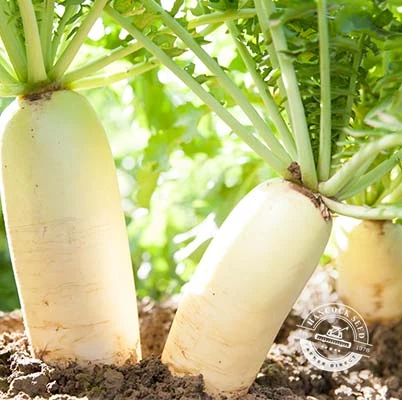
Radish is popular in cover crop systems because it delivers substantial benefits in a relatively short growing period. It establishes quickly when moisture and temperatures are favorable, producing both leafy above-ground growth and a thick taproot below the surface.
The root helps penetrate the upper soil profile, while the plant captures nutrients that might otherwise remain unused or move deeper in the soil. After termination, the radish decomposes relatively quickly, returning captured nutrients and organic material to the cropping system.
Radish is an excellent option for:
- Fall cover crops
- Soil-building programs
- Crop rotations
- Nutrient scavenging
- Compacted surface soils
- Grazing cover crops
- Multi-species cover crop blends
- Fields needing rapid fall ground coverage
Put the Taproot to Work
One of the most recognizable characteristics of cover crop radish is its large taproot.
Under favorable soil conditions, the root grows aggressively into the soil profile, creating channels and helping loosen compacted surface layers. USDA-NRCS specifically identifies alleviating soil compaction as one of the benefits of radish in cover crop systems.
Once the radish dies and decomposes, the root channel can remain behind, helping create pathways for subsequent crop roots, water, and air.
Benefits
- Helps alleviate surface compaction
- Creates root channels through the soil
- Adds below-ground organic matter
- Encourages greater rooting diversity
- Improves the physical structure of the cover crop system
- Complements fibrous-rooted grasses in blends
Capture Nutrients Before They Leave the Root Zone
Radish does not fix atmospheric nitrogen like clover, peas, cowpeas, or other legumes. Instead, one of its greatest strengths is its ability to scavenge nitrogen already present in the soil.
USDA-NRCS rates radish very good for scavenging nitrogen from the soil.
Its rapid growth and root system allow the plant to take up available nutrients and hold them in plant tissue. As the radish residue decomposes, those nutrients can cycle back into the soil.
Benefits
- Excellent nitrogen scavenger
- Captures residual soil nutrients
- Helps improve nutrient cycling
- Holds nutrients in plant biomass
- Works well following heavily fertilized crops
- Complements nitrogen-fixing legumes
Why Choose Radish Seed?
Rapid Establishment
Radish can establish quickly under favorable cool-season conditions, making it useful when growers have a relatively short window between crops.
Aggressive Taproot
The large taproot is one of the main reasons radish is included in soil-health mixes, particularly where surface compaction is a concern.
Excellent Nutrient Scavenging
Radish captures available nutrients—particularly nitrogen—and holds them in plant biomass rather than fixing new nitrogen from the atmosphere.
Helps Suppress Weeds
Rapid establishment and canopy development can compete with weeds for sunlight, nutrients, moisture, and growing space. NRCS identifies weed suppression as one of radish’s cover-crop benefits.
Produces Useful Biomass
An NRCS guide for north-central West Texas and southwestern Oklahoma lists approximately 3,000–4,000 lb./acre of biomass potential for radish under the conditions represented in that guide.
Grazing Potential
Forage radish can produce highly nutritious, fast-growing forage that may be incorporated into properly managed cool-season grazing systems.
A Versatile Addition to Southern Plains Cover Crop Blends
Radish can be particularly useful for West Texas growers who want to increase rooting diversity and nutrient cycling in a fall or cool-season cover crop.
USDA-NRCS guidance for north-central West Texas and southwestern Oklahoma identifies radish for erosion prevention, weed suppression, and alleviating soil compaction. The same guidance lists radish as a potential mixture partner with other brassicas, mustards, small grains, and legumes.
For West Texas growers, radish can fit well alongside crops such as:
- Wheat
- Triticale
- Rye
- Oats
- Barley
- Turnips
- Clover
- Winter peas
- Other cool-season cover crops
The combination of radish’s taproot with the fibrous roots of small grains and nitrogen-fixing ability of legumes can create a much more diverse below-ground system than planting a single species.
Radish Planting Recommendations
Radish is a small-seeded crop and should generally be planted shallow into a firm seedbed with good seed-to-soil contact.
General Planting Information
- Growth Habit: Cool-season annual broadleaf/brassica
- Planting Depth: Approximately ¼–½ inch
- Planting Method: Drill or broadcast
- Primary Season: Late summer through fall
- Primary Uses: Cover crop, soil improvement, nutrient scavenging, biomass, and grazing
- Winter Hardiness: Generally winter-kills under sufficiently cold conditions
USDA-NRCS guidance consistently lists a planting depth of approximately ¼ to ½ inch for radish.
Seeding Rate
Seeding rates should be adjusted according to seed type, planting method, location, and whether radish is planted alone or in a mixture.
An NRCS guide developed for north-central West Texas and southwestern Oklahoma lists:
- Radish Seeding Rate: approximately 8 lb./acre
- Planting Depth: ¼–½ inch
Other NRCS recommendations for forage radish range approximately 7–13 lb./acre, demonstrating why seeding rate should be matched to the production system rather than using one rate everywhere.
When planting radish as part of a diverse blend, the radish rate is typically reduced to prevent it from dominating smaller or slower-growing species.
Contact Jack Seed & Supply for a planting rate based on your acreage, planting method, and cover crop blend.
What Does Radish Bring to the Field?
Crop Type: Cool-season annual brassica
Scientific Name: Raphanus sativus
Primary Uses: Cover crop, nutrient scavenging, soil improvement, biomass, and grazing
Growth: Rapid under favorable cool-season conditions
Planting Depth: ¼–½ inch
West Texas NRCS Seeding Rate: Approximately 8 lb./acre in a pure stand
Root System: Large taproot
Nitrogen Fixation: None
Nitrogen Scavenging: Very Good
Compaction Management: Excellent use case
Weed Suppression: Good
Residue Persistence: Fair
Biomass Potential: Approximately 3,000–4,000 lb./acre in the cited West Texas/Southwestern Oklahoma NRCS guide
Season: Cool season
USDA-NRCS identifies radish as a fast-growing cover crop with strong nutrient-scavenging characteristics and benefits for weed suppression, erosion prevention, and soil compaction management.
What is cover crop radish?
Cover crop radish is a fast-growing annual brassica planted primarily for soil improvement, nutrient scavenging, biomass, weed competition, grazing, and its large taproot.
Does radish fix nitrogen?
No. Radish scavenges existing nitrogen from the soil rather than fixing atmospheric nitrogen.
Does radish help with soil compaction?
Its aggressive taproot can help penetrate and loosen compacted surface soil. NRCS specifically lists alleviating soil compaction as one of the crop’s uses.
How deep should radish seed be planted?
A general recommendation is approximately ¼ to ½ inch deep.
How much radish seed should I plant per acre?
An NRCS guide for north-central West Texas and southwestern Oklahoma lists approximately 8 lb./acre. Rates should be reduced when radish is incorporated into a multi-species blend.
Can livestock graze radish?
Forage radish can be incorporated into grazing systems and produces nutrient-rich forage. Grazing management should account for the complete diet and the amount of brassica forage available.
Is radish good in a cover crop blend?
Yes. It pairs especially well with fibrous-rooted small grains and legumes, giving a blend greater root diversity and multiple soil-health functions.

Reviews
There are no reviews yet.