Put Challenging Acres Back into Forage Production
One of the biggest reasons to consider Hercules Tall Wheatgrass is its ability to perform where soil conditions make pasture establishment difficult.
Hercules is particularly suited to high-pH and alkaline ground. It has been reported establishing on soils with pH levels as high as 10.1, although performance at any individual site will depend on the complete soil profile, salinity, drainage, fertility, and available moisture.
Potential applications include:
- High-pH fields
- Alkaline soils
- Saline ground
- Difficult pasture acres
- Lower-fertility fields
- Irrigated pasture
- Hay production
- Long-term grazing systems
For producers dealing with problem ground, this soil tolerance can be one of Hercules’ most valuable characteristics.
Extend the Productive Grazing Period
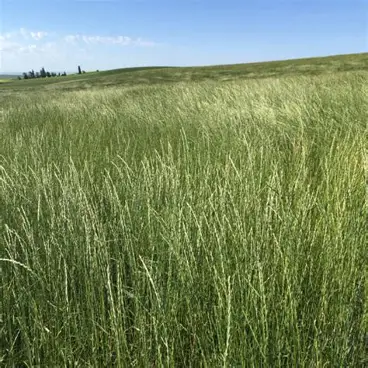
Hercules is late maturing, helping it remain vegetative longer before producing mature seed heads.
That characteristic can contribute to a longer grazing window when the stand is properly managed.
Grazing Benefits
- Long grazing period
- Strong forage production
- Early spring growth
- Perennial stand
- Good establishment vigor
- Useful on difficult soils
- Suitable for rotational grazing
- Late maturity
For best forage quality, livestock should utilize Hercules before the grass heads out. As with most perennial grasses, forage quality declines as stems and seed heads mature.
High-Yielding Perennial Hay Production
Hercules can also be used as a perennial hay grass.
Its vigorous, upright growth provides good biomass potential, while its later maturity provides producers with a useful harvest window.
Hay Production Benefits
- High forage yield potential
- Perennial production
- Strong spring growth
- Upright growth habit
- Adaptation to difficult soils
- Useful on high-pH acreage
Timing is especially important when producing hay.
Harvesting before advanced heading generally provides better palatability and forage quality, while delaying harvest increases maturity and stem content.
Key Features
High Yield Potential
Hercules was selected as a productive forage type and can produce substantial forage under suitable fertility and moisture conditions.
Late Maturity
Later heading helps extend the vegetative period and provides a longer window for grazing or hay harvest.
Excellent Seedling Vigor
Strong seedling vigor helps Hercules establish into a productive perennial stand.
High-pH Tolerance
Hercules is particularly valuable on alkaline ground where other forage grasses may struggle.
Long Grazing Period
Its combination of early spring growth and late maturity can provide a useful grazing window.
Perennial Growth
Once established and properly managed, Hercules provides a long-term forage stand rather than requiring annual replanting.
Tough-Site Adaptation
Hercules can be particularly useful where soil chemistry limits the productivity of less tolerant forage species.
A Major Strength of Hercules
High soil pH can create serious challenges for forage production.
Nutrients may become less available, plant establishment can suffer, and some grasses simply do not tolerate strongly alkaline conditions.
Hercules Tall Wheatgrass is specifically useful in these environments.
Reported field experience shows Hercules establishing in soil with a pH as high as 10.1, and the variety has been used to improve forage coverage in alkaline portions of fields where other forage grasses performed poorly.
That makes Hercules worth considering for:
- Alkali spots
- High-pH pasture
- Saline-alkaline soils
- Problem areas under irrigation
- Fields with uneven soil conditions
A soil test is still recommended before planting so pH, salinity, fertility, and other limitations can be evaluated separately.
Establish a Long-Term Perennial Stand
Good establishment is essential because Hercules is intended to remain productive for multiple years.
General Planting Information
Crop: Tall Wheatgrass
Variety: Hercules
Crop Type: Cool-season perennial forage grass
Primary Uses: Grazing, hay, pasture
Growth Habit: Upright perennial grass
Maturity: Late
Planting Season: Fall or early spring
Sun Requirement: Full sun
Establishment: Seeded
Soil Adaptation: Particularly strong on high-pH and alkaline soils
Seedling Vigor: Excellent
The exact planting window should be adjusted to local moisture conditions and whether the field is irrigated or dryland.
Match the Rate to Your Planting Method
Tall Wheatgrass seeding rates can vary according to seed size, germination, planting method, soil conditions, and whether it is being planted alone or in a mixture.
A practical general range for a pure stand is approximately:
Drilled
10–15 lb. PLS/acre
Broadcast
15–20 lb. PLS/acre
Rates should be adjusted based on:
- Pure live seed
- Germination
- Seed purity
- Drill vs. broadcast
- Seedbed condition
- Irrigated vs. dryland production
- Straight stand vs. mixture
Use the current seed tag and Jack Seed & Supply’s recommendation for the specific lot being planted.
Keep Seed Shallow & Maintain Good Soil Contact
A clean, firm seedbed helps produce more uniform establishment.
Establishment Tips
- Control weeds before planting
- Prepare a firm seedbed
- Avoid excessively loose soil
- Plant approximately ¼–½ inch deep
- Maintain good seed-to-soil contact
- Use a grass drill when possible
- Firm broadcast seed after planting
- Avoid grazing during early establishment
Planting too deeply can reduce emergence and stand density.
What Does Hercules Bring to the Field?
Crop: Tall Wheatgrass
Variety: Hercules
Crop Type: Cool-season perennial forage grass
Primary Uses: Grazing, hay, pasture
Growth Habit: Upright perennial
Maturity: Late
Forage Yield: High
Seedling Vigor: Excellent
Early Spring Growth: Good
Grazing Period: Long
High-pH Tolerance: Excellent
Alkaline Soil Tolerance: Excellent
Low-Fertility Adaptation: Good
Forage Quality: Best before heading
Planting Season: Fall or early spring
Planting Depth: Approximately ¼–½ inch
Drilled Rate: Approximately 10–15 lb. PLS/acre
Broadcast Rate: Approximately 15–20 lb. PLS/acre
Life Cycle: Perennial
West Texas Use: Particularly useful for difficult high-pH and alkaline soils
What is Hercules Tall Wheatgrass?
Hercules is a late-maturing perennial Tall Wheatgrass selected for forage production, seedling vigor, long grazing potential, and performance on difficult high-pH soils.
Is Hercules Tall Wheatgrass good for cattle?
Yes. Hercules is primarily used as a forage grass for grazing and hay.
Is Hercules good for high-pH soil?
Yes. High-pH and alkaline soil tolerance are among its strongest characteristics. Hercules has been reported establishing in soil with a pH as high as 10.1.
Is Hercules Tall Wheatgrass a perennial?
Yes. It is a cool-season perennial forage grass.
Is Hercules late maturing?
Yes. Late maturity is one of its key characteristics and helps provide a longer grazing window.
Is Hercules good for hay?
Yes. It can produce high forage yields and be harvested for hay. Harvest before advanced maturity when better forage quality is the priority.
When should Hercules be grazed?
For better quality, Hercules should generally be grazed while vegetative and before heading.
How much Hercules Tall Wheatgrass should I plant?
A practical general range is approximately 10–15 lb. PLS/acre drilled, with higher rates used for broadcasting. Adjust the final rate according to the seed tag and planting conditions.
How deep should Hercules be planted?
Approximately ¼–½ inch is a useful general range. Avoid deep planting.
Can Hercules grow on poor soils?
It is particularly noted for performance on lower-fertility and high-alkali soils, although adequate nutrients and moisture are still necessary for high forage production.
Is Hercules good for West Texas?
It can be a useful option, particularly where high soil pH, alkalinity, or salinity makes establishing other perennial forage grasses difficult.
Reviews
There are no reviews yet.