Multiple Grasses Working Together
The blend contains:
30% Blue Grama
18% Sideoats Grama
16% Green Sprangletop
10% Yellow Bluestem
What Each Grass Contributes
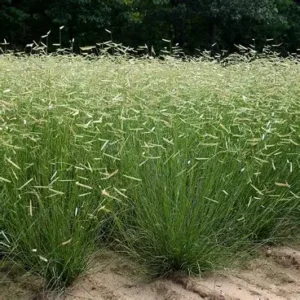
Blue Grama provides exceptional drought tolerance, grazing value, and low-growing shortgrass persistence.
Sideoats Grama adds greater height, warm-season forage production, and strong grazing value.
Green Sprangletop contributes leafy bunchgrass growth, drought adaptation, and additional warm-season forage diversity.
Yellow Bluestem adds taller perennial growth, forage production, and adaptation to dry Southern Plains conditions.
Together, the mixture provides a broader range of growth habits than a single-species pasture.
Don’t Depend on One Grass to Do Everything
Pasture conditions can change considerably across a single property.
Differences in:
- Soil texture
- Slope
- Rainfall
- Water-holding capacity
- Grazing pressure
- Fertility
- Exposure
can favor different grasses.
A multi-species pasture blend gives the stand more opportunities to establish grasses suited to those varying conditions.
Rather than expecting one grass to dominate every acre, the goal is to create a diverse perennial pasture community.
Key Features
Multi-Species Pasture
Multiple grasses provide greater diversity than establishing a single-species stand.
Excellent Drought Adaptation
Blue Grama, Sideoats Grama, Green Sprangletop, and Yellow Bluestem are all adapted to environments that experience periods of limited moisture.
Good Grazing Potential
The blend contains multiple grasses capable of providing useful warm-season livestock forage.
Multiple Growth Heights
Short-, mid-, and taller-growing grasses create greater pasture structure.
Long-Term Perennial Cover
The primary listed components are perennial grasses intended to persist rather than require annual replanting.
Strong West Texas Fit
The blend’s drought adaptation and warm-season growth make it particularly relevant to West Texas and Southern High Plains conditions.
Lower-Input Potential
Once established, these grasses can provide perennial ground cover without the intensive management associated with high-input irrigated forage systems.
Build a Diverse Warm-Season Grazing Base
This blend can be used to establish perennial cattle pasture where persistence and drought adaptation are major priorities.
Rather than producing the uniform growth of a monoculture, the individual grasses may contribute differently throughout the growing season and across different parts of the field.
Grazing Benefits
- Multiple forage species
- Warm-season production
- Good drought persistence
- Perennial pasture
- Useful forage diversity
- Suitable for rotational grazing
- Adaptation to variable field conditions
- Reduced dependence on a single grass
Stocking rate should always be based on actual forage production rather than the acreage alone.
Establish During the Warm-Season Planting Window
The primary components are warm-season perennial grasses and should be planted when soil temperature and seasonal moisture favor establishment.
General Planting Information
Crop Type: Warm-season perennial pasture blend
Primary Uses: Grazing, pasture, conservation, reclamation
Growth Habits: Shortgrass and bunchgrasses
Planting Season: Spring into early summer
Sun Requirement: Full sun
Establishment: Seeded
Planting Method: Native grass drill or broadcast
Planting Depth: Approximately ⅛–¼ inch
Water Requirement: Low once established
Drought Tolerance: Excellent
A native grass drill is generally preferred because several of the species have relatively small seed that should not be planted deeply.
Use the Bag Tag to Determine the Final Rate
Because this is a multi-species blend, the appropriate seeding rate depends on the complete formulation, seed purity, germination, and Pure Live Seed percentage.
The composition provided accounts for 74% of the mixture, so a precise whole-blend seeding rate should not be calculated until the remaining 26% and current seed analysis are known.
Final Seeding Rate Should Consider:
- Complete blend composition
- Pure Live Seed
- Germination percentage
- Seed purity
- Drill vs. broadcast
- Soil conditions
- Available moisture
- Intended pasture density
Use the current bag tag and Jack Seed & Supply’s recommendation to determine pounds per acre for the specific seed lot.
What’s in the Blend?
Blue Grama: 30%
Sideoats Grama: 18%
Green Sprangletop: 16%
Yellow Bluestem: 10%
Other Components: 26% not specified
Crop Type: Warm-season perennial pasture mixture
Primary Uses: Grazing, pasture, conservation, reclamation
Growth Structure: Shortgrass and bunchgrass mixture
Drought Tolerance: Excellent
Heat Tolerance: Excellent
Water Requirement: Low
Primary Growing Season: Warm season
Sun Requirement: Full sun
Planting Depth: Approximately ⅛–¼ inch
Planting Method: Native grass drill preferred
Grazing Value: Good
Life Cycle: Perennial for the listed components
West Texas Adaptation: Excellent
What is in the Pasture Grass Blend?
The specified composition contains 30% Blue Grama, 18% Sideoats Grama, 16% Green Sprangletop, and 10% Yellow Bluestem. Those ingredients account for 74% of the mixture, so check the current seed tag for the remaining components.
Is the Pasture Grass Blend good for cattle?
Yes. The mixture contains multiple warm-season grasses that provide useful livestock forage and can be used to establish perennial cattle pasture.
Is this a native grass blend?
It contains several native grasses, including Blue Grama, Sideoats Grama, and Green Sprangletop. Yellow Bluestem is an introduced Old World Bluestem, so the mixture should not be described as a 100% native blend.
Is the Pasture Grass Blend drought tolerant?
Yes. Excellent drought adaptation is one of the blend’s primary strengths.
Is it good for West Texas?
Yes. The listed grasses are well suited to warm, dry Southern Plains environments, making the mixture particularly relevant to West Texas pasture establishment.
Can it be planted on dryland acres?
Yes. Dryland pasture is one of its potential applications, although establishment and forage production will depend on rainfall.
When should I plant the Pasture Grass Blend?
Spring into early summer is generally the appropriate window for warm-season perennial grass establishment, with exact timing depending on soil temperature and moisture.
How deep should I plant it?
Approximately ⅛–¼ inch is a useful general target. Avoid planting the small-seeded components too deeply.
How many pounds per acre should I plant?
Use the current bag tag and recommended rate for the complete mixture. The supplied composition only accounts for 74% of the blend, so I would not publish a specific whole-blend pounds-per-acre rate without knowing the remaining 26%.
Is it better than Bermudagrass?
It depends on the goal. Bermudagrass is excellent for higher-input, high-production pasture. This blend is better suited to situations where species diversity, drought persistence, and lower-input pasture are priorities.
How soon can cattle graze it?
Wait until the stand is well established and plants resist being pulled from the soil. New perennial pasture should generally be protected from heavy grazing during establishment.

Reviews
There are no reviews yet.